Catalog
Home
Wishlist
0
Compare
0
Contacts

Raspberry Pi 5 16GB

Brand: Raspberry Pi Product Code: SC1113
0
All about product
Description
Specification
Reviews 0
Questions0
new
Sold Out
Raspberry Pi 5 16GB
Raspberry Pi 5 16GB
Raspberry Pi 5 16GB
Raspberry Pi 5 16GB
Raspberry Pi 5 16GB
Raspberry Pi 5 16GB
Raspberry Pi 5 16GB
Out Of Stock
£310.00
RAM: 16GB
Bluetooth:Bluetooth 5.0
Cores:quad-core
Country of origin:Made in UK
Ethernet:10/100/1000 Ethernet
Form factor:Raspberry Pi 5
Delivery
Royal Mail 1st Class
£3.50
DHL Express
DHL Express
£9.99
Payment
ApplePay ApplePay
Google Pay Google Pay
bank transfer bank transfer
Secure Payment
Your payment information is processed securely.
We do not store credit card details.
Raspberry Pi 5 16GB
£310.00
Description

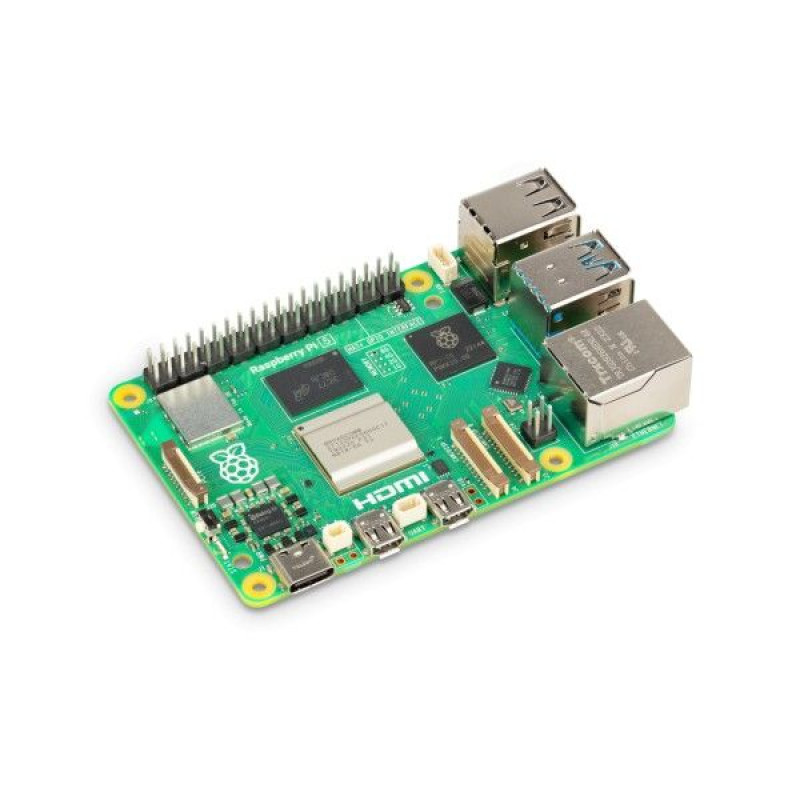
The Raspberry Pi 5 Board 16GB microcomputer is the fifth generation of a single-board computer designed for a variety of applications in the field of computing and the Internet of Things (IoT). This device is characterized by a powerful hardware platform and a variety of project development capabilities.

The Raspberry Pi 5 is based on an updated processor and includes various ports and interfaces for connecting various devices such as monitors, cameras, sensors, and many others. With a 64-bit quad-core Arm Cortex-A76 processor running at 2.4 GHz, the Raspberry Pi 5 delivers a 2-3x increase in CPU performance compared to the Raspberry Pi 4.

Thanks to the new 800 MHz VideoCore VII GPU, graphics performance has been significantly improved (dual 4Kp60 display output via HDMI), and camera support from the updated Raspberry Pi Image Signal Processor.

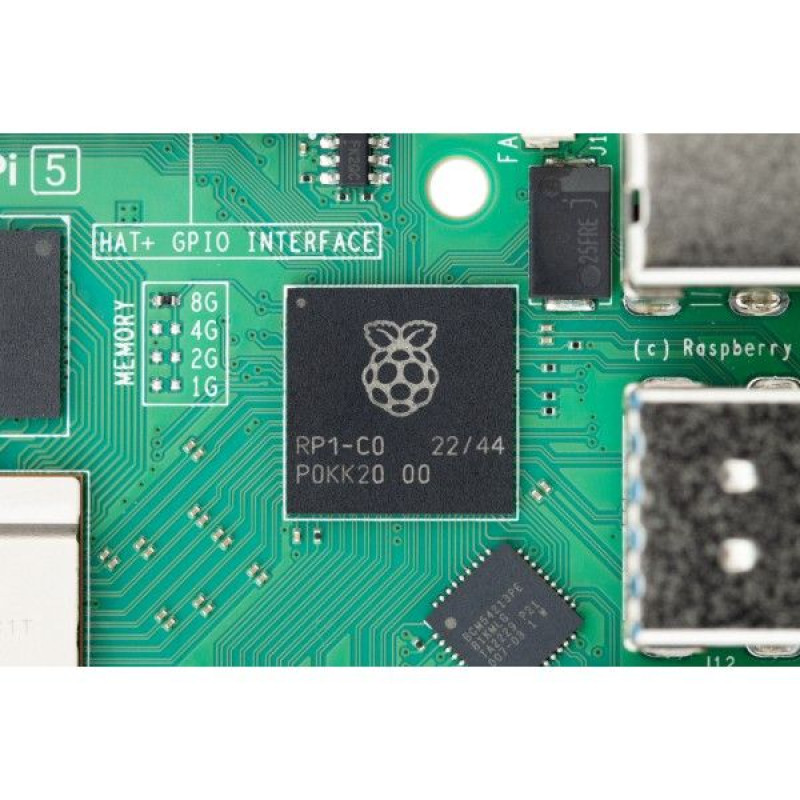
The RP1 controller chip provides the bulk of the I/O capabilities for the Raspberry Pi 5:

  • total USB bandwidth has been more than doubled, providing faster data transfer rates to external UAS drives and other high-speed peripherals;
  • the dedicated 1 Gbps dual-band MIPI camera and display interfaces found in previous models have been replaced with a pair of 1.5 Gbps quad-band MIPI transceivers, tripling the overallbandwidth and supporting any combination of up to two cameras or displays;
  • maximum SD card performance is doubled with support for high-speed SDR104 mode;
  • For the first time, the platform demonstrates a single-channel PCI Express 2.0 interface, which provides support for high-bandwidth peripherals.

The board has built-in Wi-Fi and Bluetooth wireless connectivity, making it easy to connect to the network and other devices.

The Raspberry Pi 5 supports a variety of operating systems and programming languages, making it a versatile tool for developers and makers. It's ideal for creating IoT projects, servers, media centers, emulators, and many other applications that require a reliable and powerful computing platform. The Raspberry Pi 5 is a convenient and affordable tool for realizing technical and creative ideas.

Main features:

  • Quad Arm Cortex-A76 at 2.4 GHz
    • Support for Cryptographic Extension (AES on hardware)
    • 512 KB of L2 cache per core
    • 2 MB of L3 cache
  • 16 GB LPDDR4X-4267 SDRAM
  • Dual HDMI 4kp60 display output with HDR support
  • 4kp60 HEVC decoder
  • VideoCore VII graphics with OpenGL-ES 3.1, Vulkan 1.2
  • Raspberry Pi image sensor processor (ISP)
  • Raspberry Pi connector for PCIe (1 port 2.0, additional expansion card required)
  • 802.11ac dual-band Wi-Fi
  • Bluetooth 5.0 (with BLE support)
  • Gigabit Ethernet
  • PoE support (optional expansion card required)
  • 2x USB 3.0 (with the possibility of simultaneous full bandwidth)
  • 2x USB 2.0
  • Dual 4-channel MIPI CSI/DSI transceivers, support for
    • 2x displays; or
    • 2x cameras; or
    • 1x display + 1x camera
  • 40-pin Raspberry Pi GPIO connector
  • Fan connector
  • Real-time clock (RTC)
    • RTC battery connector
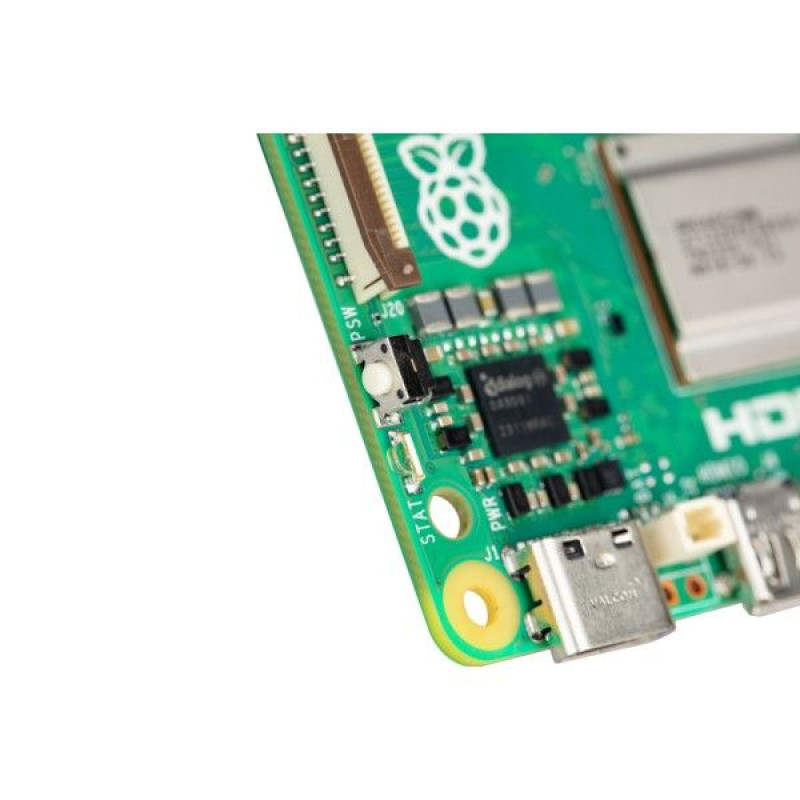
  • Power button

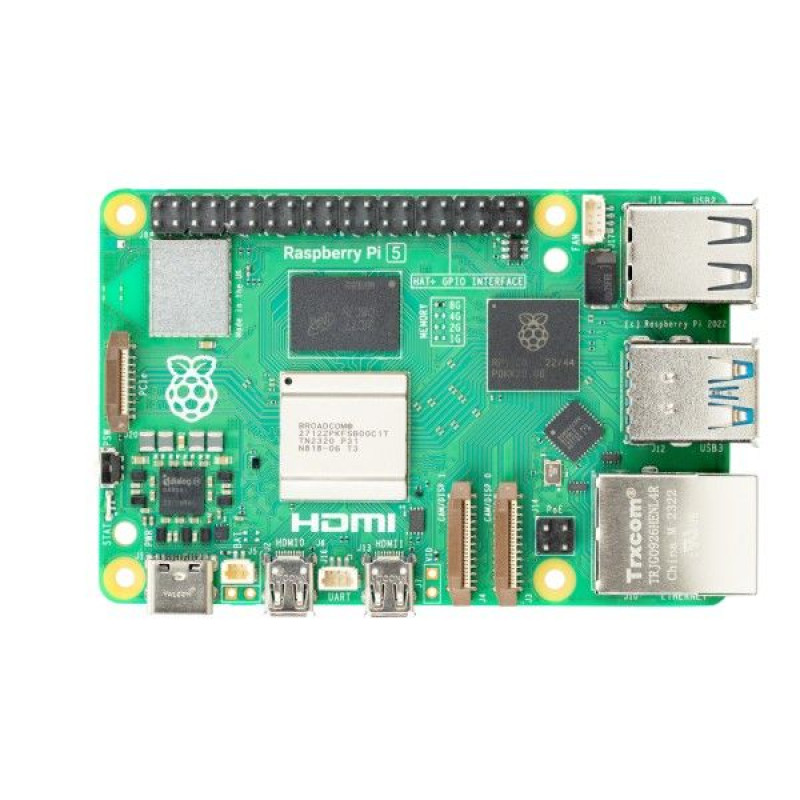
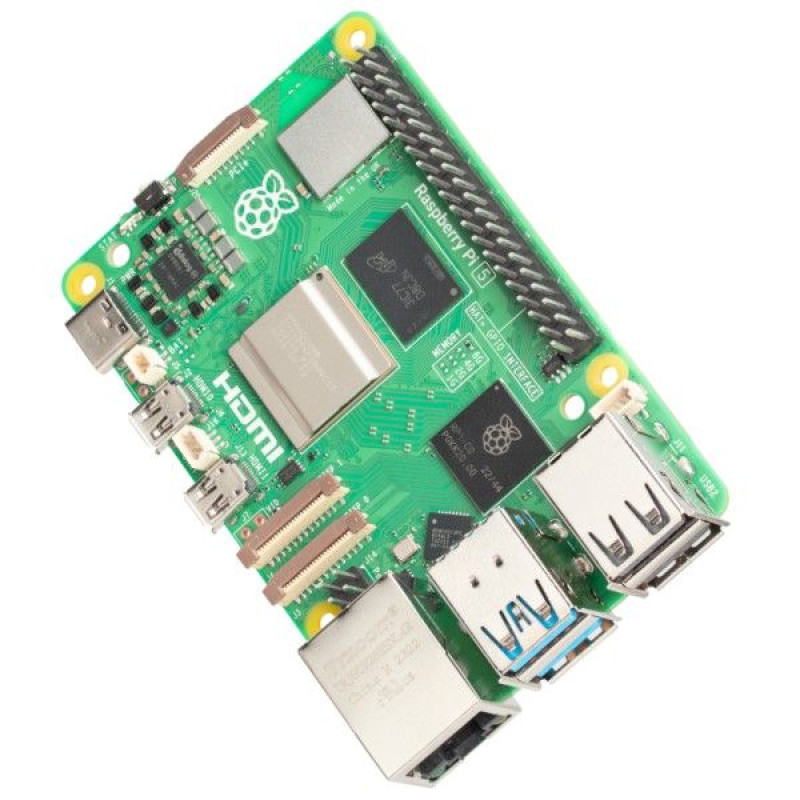
Elements of the board:

Adding your own power button
Jumper J2, located between the RTC battery connector and the edge of the board, is a breakthrough that allows you to add your own power button to the Raspberry Pi 5 by adding a normally open (NO) momentary switch that connects the two panels. Short-circuiting this switch will perform the same actions as the built-in power button.

Powering the Raspberry Pi 5

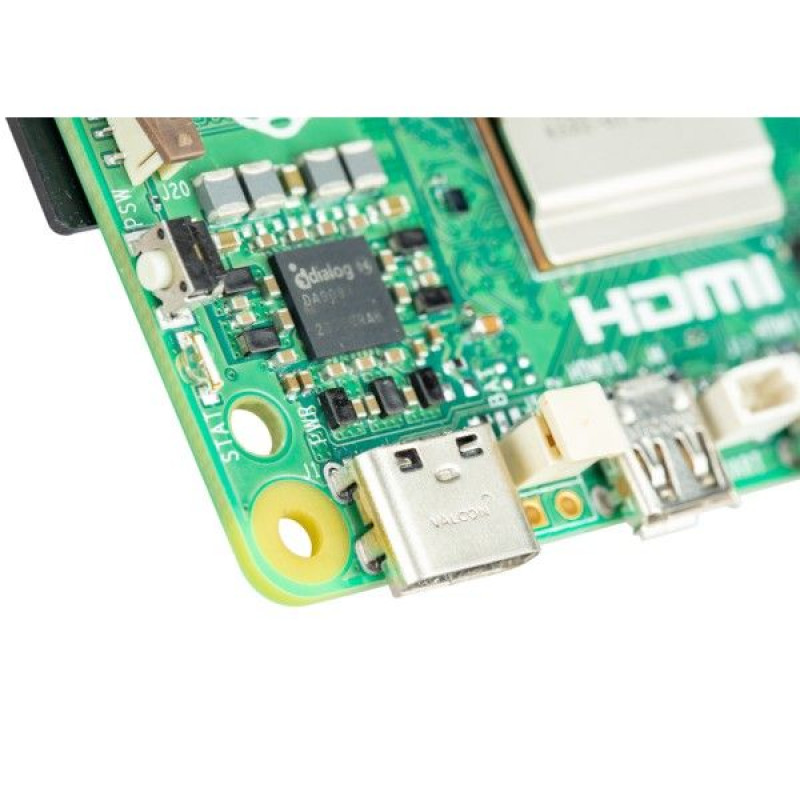
Raspberry Pi makes two different USB-C power supplies. The first is the Raspberry Pi 15W USB-C power supply, recommended for the Raspberry Pi 4 and Raspberry Pi 400. The second is the Raspberry Pi 27W USB-C power supply, which delivers up to 5A at +5.1V and is the recommended power supply for the Raspberry Pi 5.

The USB-C standard used in the Raspberry Pi 4 shipment is limited to 5V at 3A for a total output power of 15W. The USB-PD standard allows for higher voltages and currents to be matched via software (5.1V, 5A; 9V, 3A; 12V, 2.25A; 15V, 1.8A), but requires the appropriate Power Management Integrated Circuit (PMIC), which is only available on the Raspberry Pi 5. These power supplies require the use of appropriate USB-PD compatible cables.

NOTE.
It is not possible to use old "dumb" USB cables and connectors to provide more than 15 watts, even with a USB-PD compatible power supply.
Although USB-PD-compatible phone chargers advertise more than 15W, almost all of them achieve this by increasing the voltage instead of increasing the current at +5V. If you use a power supply that cannot provide 5A at +5V during the first boot, the operating system will warn you that the current consumption of peripherals will be limited to 600mA.


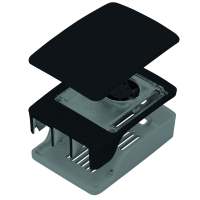
The Raspberry Pi 5 was designed to handle typical customer workloads without a case and without active cooling. For heavy workloads, there are two official Raspberry Pi 5 cooling options (Fan Case and Active Cooler) and both connect to the four-pin JST PWM fan connector located on the top right of the board between the 40-pin GPIO connector and USB 2. Both available official accessories are actively controlled by the Raspberry Pi firmware: at 60°C the fan will turn on, at 67.5°C the fan speed increases, and finally at 75°C the fan reaches full speed. When the temperature drops below these limits again, the fan automatically starts to reduce its speed.

Raspberry Pi connector for PCIe

The Raspberry Pi 5 has an FPC connector on the right side of the board. This connector provides a PCIe Gen 2.0 x1 interface for fast peripherals.

MIPI CSI/DSI connectors

The CSI and DSI ports found on previous Raspberry Pi models have been combined into two dual-purpose CSI/DSI (MIPI) ports. To print them on the board, a tighter connector pinout is now used, which was previously only available on the Raspberry Pi Zero and CM4IO board. You can connect two displays, two cameras, or one camera and one display to these ports.

If you are using a MIPI device other than a Raspberry Pi - a camera or display - it will not be automatically configured for your Raspberry Pi 5. Instead, you will need to add the dtoverlay parameter to /boot/firmware/config. txt to properly configure the correct port for the desired camera or display.

These dtoverlay settings should be provided by your device manufacturer. For example, adding dtoverlay=ov9281 will configure an Omnivision OV9281-based camera on CSI/DSI1, while adding dtoverlay=ov9281,cam0 will add the same camera on CSI/DSI0.

UART connector

The Raspberry Pi 5 has a dedicated UART connector for debugging. It has a maximum baud rate of 921,600 bps, which can be customized using the EEPROM parameter. It is always active and enabled, and provides direct access to early boot and firmware information; as well as the Linux console after boot.

The UART connector is a three-pin connector compatible with the Raspberry Pi debug connector specification. A cable with the appropriate JST connector to allow connection to the UART is supplied with the debugging probe.

Real-time clock (RTC)

The Raspberry Pi 5 contains an RTC module. It can be powered by a battery via the J5 (BAT) connector on the board, located to the right of the USB-C power connector.
It can be used to set an alarm that puts the board into a very low power consumption state (approximately 3 mA). When it is time for the alarm, the board will turn back on. This can be useful for intermittent tasks, such as slow motion.

Power over Ethernet (PoE) connector.

The Ethernet connector on the Raspberry Pi 5 is PoE+ enabled and supports the IEEE 802.3at-2009 PoE standard. The Raspberry Pi 5 has a 4-pin Power-over-Ethernet (PoE) connector block located between the Ethernet connector and the two MIPI connectors.

Overall dimensions: 85 mm x 56 mm

Specifications
Main characteristics
Bluetooth
Bluetooth 5.0
Cores
quad-core
Country of origin
Made in UK
Ethernet
10/100/1000 Ethernet
Form factor
Raspberry Pi 5
HDMI
2 x micro-HDMI
Processor
Cortex-A76 @ 2.4GHz
RAM
16GB
Storage
Micro SD card
USB
2 x USB 3.0 / 2 x USB 2.0
Wi-Fi
2.4 GHz / 5.0 GHz
Reviews

There are no reviews for this product.

There are no reviews for this product, be the first to leave your review.

Answers & questions
Add your question and we will answer as soon as possible.

No questions about this product, be the first and ask your question.