We do not store credit card details.
Coral M.2 Accelerator with Dual Edge TPU
We do not store credit card details.
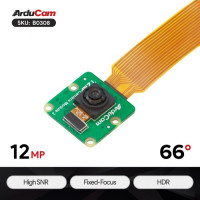
TheCoral M.2 Accelerator with Dual Edge TPU is a small ASIC (Application Specific Integrated Circuit) developed by Google that includes two ML Edge TPU accelerators, each with its own PCIe Gen2 x1 interface, designed to accelerate the execution of TensorFlow Lite model calculations with low power consumption. Each is capable of performing 4 trillion operations per second (4 TOPS) using 2 watts of power - that's 2 TOPS per 1 watt. For example, a single Edge TPU can do the calculations for the most advanced mobile vision models, such as MobileNet v2, processing nearly 400 frames per second.
Processing the machine learning algorithm on the device reduces latency, improves data privacy, and eliminates the need for a constant internet connection.
With two Edge TPUs in this module, you can double the number of outputs per second (8 TOPS) in several ways, such as parallel execution of tasks on two accelerators or pipeline processing of one model on both Edge TPUs.
Warning. Because this module uses two PCIe x1 connections, it is not compatible with all M.2 E-key card slots. The dual Edge TPU also requires special power requirements that must be carefully verified.
Key Features:
● 2 Google Edge TPU ML accelerators.
○ Total peak performance of 8 TOPS (int8)
2 TOPS per watt
● Integrated power management
2 PCIe Gen2 x1 interfaces (one for each Edge TPU)
● M.2-2230-D3-E module
Dimensions: 22.0 x 30.0 x 2.8 mm.
Operating temperature: -40 to +85 °C
The power consumption of the card module depends on the machine learning model, the number of outputs per second, and the operating frequency of each Edge TPU. The maximum current consumed by each Edge TPU is usually much higher than the average current. This is because when an Edge TPU executes a machine learning model, it activates a large number of arithmetic logic units (ALUs) many times at the same time, resulting in a pattern of short but large current transients. Each model architecture also activates a different set and different number of ALUs, which means that the magnitude and shape of the transient current is very much model dependent.
Although the average current drawn from the 3.3V supply by each Edge TPU is typically less than 500 mA, short-term transients occurring during logic output can reach approximately 3 A. These outliers also occur suddenly: even a simple model can generate excessive transients. 1 A/µs from a single Edge TPU. However, these numbers are only representative of models tested at Google, and your numbers may vary. To determine the actual peak current, you should observe the current when running the models you will deploy in production and compare the currents when running one Edge TPU or both Edge TPUs in parallel.
Support for TensorFlow Lite
Coral M.2 Accelerator with Dual Edge TPUs supports TensorFlow Lite, so you don't have to build models from scratch. TensorFlow Lite models can be compiled to run on the Edge TPU.
Overall dimensions: 30mm x 22mm x 2.8mm

Software requirements:
The M.2 accelerator with Dual Edge TPU must be controlled by the Edge TPU runtime and the Coral PCIe driver, which is compatible with the following systems:
● Linux:
○ 64-bit version of Debian 10 or Ubuntu 16.04 (or later)
○ x86-64 or ARMv8 system architecture
● Windows:
○ 64-bit version of Windows 10
○ x86-64 system architecture
All systems require MSI-X support in accordance with the PCI 3.0 specification.
Temperature limitations:
The junction temperature of each Edge TPU Tj must remain below the maximum operating temperature:
● Maximum Edge TPU Tj junction temperature: 115°C.
Warning: Exceeding the maximum temperature may cause irreversible damage to the Edge TPU and surrounding components and may also cause a fire.
There are no reviews for this product.
There are no reviews for this product, be the first to leave your review.
No questions about this product, be the first and ask your question.